
FAQ: Green Bin Program in the County of Essex
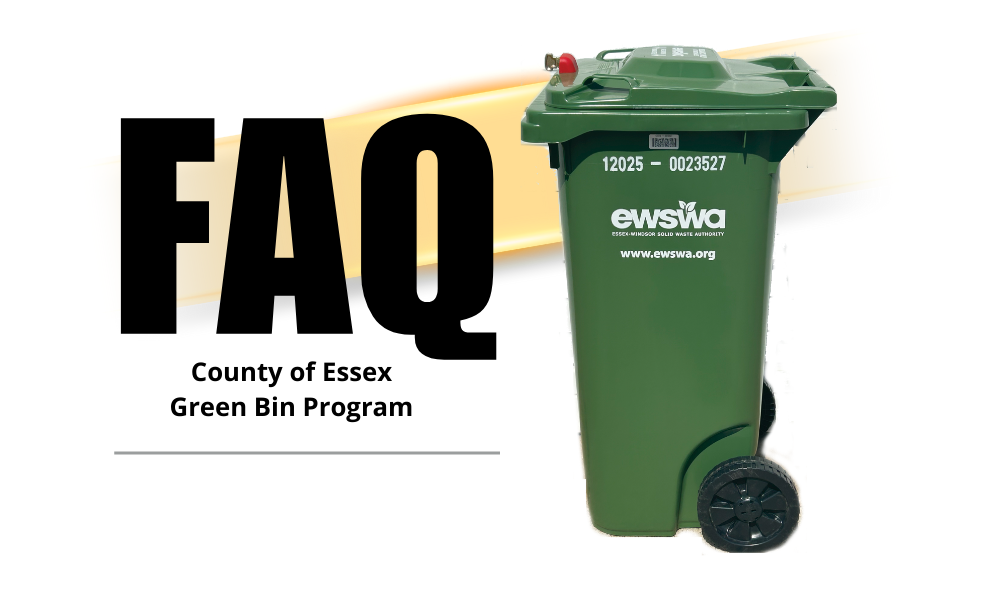
Q: Why did the County launch a Green Bin program?
A: The Province of Ontario mandated the collection of food and organic waste through curbside pick-up, public drop-off sites or community composting programs for urban settlement areas in municipalities of a certain population and/or population density. In our County, Amherstburg, LaSalle, Leamington and Tecumseh triggered these population and/or density thresholds. The mandate required these local municipalities to achieve target diversion rates of 50 per cent generated by single-family dwellings in urban settlement areas by 2025.
Kingsville, Lakeshore and Essex are not yet required to collect food and organic waste or meet diversion targets, but these local municipalities were included in the regional program. County Council voted on March 16, 2022, to include all County of Essex municipalities in a regional organics program. Similarly, the provincial mandate does not apply to rural settlement areas yet. However, County Council voted on June 5, 2024, to include both rural and urban residential properties in the program.
When determining whether all local municipalities and both urban and rural households would be included, the service levels for other waste programs were considered. All households captured in the Green Bin program are also receiving garbage and recycling services.
Additionally, all local municipalities continue to grow in population and density. The municipalities that currently don’t trigger inclusion are expected to be subject to provincial mandates related to organic waste in the future. An organics program that provides consistent service across all residential households is not only forward thinking but also ensures everyone in Essex County is helping to extend the life of the Essex-Windsor Regional Landfill.
Q: Why was curbside collection chosen instead of other organic program options?
A: The Green Bin program is required to result in an organic diversion target of 50 per cent. Research and industry best practice suggests that the success of any Green Bin program rests heavily with its ease of participation. When weighing the cost of establishing seven drop-off transfer stations against the probability of achieving the 50 per cent diversion target, the recommendation approved by County Council was to establish a curbside collection program.
Q: Did the Province provide funding for this program?
A: No, the Province made the collection of food and organic waste mandatory in certain local municipalities but did not provide any funding to help pay for it. The County and City are responsible for the costs of this provincial mandate.
Q: Who is responsible for this program and what is the Essex-Windsor Solid Waste Authority?
A: The County of Essex is responsible for establishing the level of Green Bin service.
The Essex-Windsor Solid Waste Authority (the Authority or EWSWA) is a Joint Board of Management created by the County of Essex and the City of Windsor in 1994 to establish, operate, and manage the Regional Landfill, public drop off depots as well as all waste diversion programs. Included in the agreement is a condition that, until otherwise determined by the municipalities, traditional waste collection would remain the responsibility of the individual local municipalities.
The costs EWSWA incurs to deliver the Green Bin program are tabulated for each municipality. The City receives its bill and the County receives a consolidated bill for the seven local municipalities in Essex County. The County is preparing to recover the cost of this program by collecting a user fee charge from all residential households with access to the service. The charge for Green Bin service would appear as a separate charge on residential tax bills.
Q: Why is the cost of the program being handled in this fashion?
A: At its meeting of June 5, 2024, County Council reviewed a range of funding models for taxpaying residents of the County’s seven municipalities, and ultimately endorsed a hybrid model, which combines the County levy-based funding model with a user-fee methodology to cover new expenses associated with the Green Bin program.
County Council approved a hybrid user-fee approach to recover costs from only those County residents who have access to the Green Bin Program. For 2025, that includes Essex, Lakeshore, LaSalle and Tecumseh. Amherstburg, Kingsville and Leamington come on board in the fall of 2026. Council approved this approach as it did not want to charge residents for a service that some could not access.
Under this hybrid user-fee approach, each municipality’s tonnage/use of the Green Bin program is used to calculate a unique user fee, on a “per-residential-property” basis for that municipality. The user fee will then appear on the property tax bill for each residential property with access to the service. Estimated annual fees for each municipality were provided in a Dec. 17, 2025, report to County Council. The estimated cost of the Green Bin program was also communicated publicly in July 2024 by EWSWA to all media outlets in the region. The estimate communicated in 2024 was $2 to $3 per household per week.
Q: Has Council approved the final household cost for the Green Bin program?
A: No. Council has not yet approved the final household user fee. The figures previously shared were estimates included in a December 17, 2025, council report to help inform discussion and planning.
The final household cost will be confirmed through a User Fee By-law, which is scheduled to be considered by County Council on Feb. 18, 2026. Billing will only occur after Council approves the by-law.
Estimated costs were shared in advance to provide transparency and early awareness, while final property counts and program details were being finalized to ensure accuracy.
Q: Where and when will I see this user fee charge?
A: The charge will appear as “CTYBIN” in the “user fee/other” section of your residential tax bill.
No Green Bin user fees have been billed to date. Charges will only be applied after Council approves the User Fee By-law.
Phase 1 municipalities (Essex, Lakeshore, LaSalle and Tecumseh) will see the charge for the first time in 2026 and be billed for service that began in 2025 through to Dec 2026 (approximately 15 months). Beginning in 2027, the annual user fee will represent 12 months of service. Phase 2 municipalities (Amherstburg, Kingsville, and Leamington) will join the program in approximately October 2026, with their first billing not appearing until the 2027 property tax bill. Similar to Phase 1 municipalities, Phase 2 municipalities will be billed in 2027 for service that began in 2026 through to December 2027 (approximately 15 months). Beginning in 2028, the annual user fee will represent 12 months of service.
Q: Does charging a user fee increase the cost of the program?
A: No. The cost of the Green Bin program is the same regardless of how it is funded. The user fee does not change the cost of the program, it only determines how the cost is allocated. Council chose a model that charges only households receiving the service, rather than spreading the cost across all taxpayers and property classes.
Q: Why is the focus on residential organic waste and not commercial and/or industrial organic waste? Why aren’t commercial and industrial properties being charged for the Green Bin program?
A: Provincial legislation currently does not require non-residential properties to divert their organic waste. Only residential properties in County municipalities are being charged for the Green Bin service, as commercial and industrial properties are not receiving the service.
Q: Why can’t I opt out of the program?
A: Councils of both the County of Essex and City of Windsor approved a regional program that supported residential homes and multi-residential buildings under six units having access to the Green Bin program. This is also how the Blue Box program was administered. So, even if a resident chooses to put food waste in the garbage and not the Green bin, they still have access to the organics program and still pay for the service. Additionally, many contracts for the Green Bin program now run well into the 2030s. So, the program is here to stay and will have tremendous environmental and economic benefits, including extending the life of the Essex-Windsor Regional Landfill.
Q: Why am I only hearing about this program now?
A: The decision to move to a regional food and organic waste collection system was made by a previous Council on March 16, 2022. Since then, there have been multiple council meetings, reports and media stories on this issue. The Essex-Windsor Solid Waste Authority has launched an extensive marketing campaign about the Green Bin program. In December, County Council received a report from County administration identifying the upcoming rollout of an awareness campaign by the County, in collaboration with local municipal tax departments. Residents will receive information in their final tax bill mailing.
Q: Do the benefits of this program justify the cost?
A: There are costs to this new program, yes, but it is important to focus on the benefits of putting food waste and organics in the Green Bin. Instead of sending the material to the landfill and using valuable airspace, it is diverted to an anaerobic digester, where the material breaks down and is used to create renewable energy and fertilizer for farmers’ crops. This process is also different than incineration, which simply burns waste to generate heat.
Q: What has been the impact of the program so far?
A: Only 13 weeks into the Green Bin launch, EWSWA estimates that 3,000 metric tonnes, or the equivalent of 60 NHL hockey arenas worth, have already been diverted from the Landfill. And that amount – and those savings – are only going to increase as more municipalities come on board, and as more residents embrace the program.
Q: Why should I care about the Essex-Windsor Regional Landfill?
A: We should all care about extending the life of the Landfill because we will all have to pay a lot of money for a new one. The cost to site a new Landfill is estimated at more than $700 million. It is far less expensive, for all of us, to embrace this Green Bin program now instead of paying the exceptionally high costs of siting a new one.
Q: With producers now paying for the recycling program, why aren’t those savings being applied to the new cost of the Green Bin program?
A: Knowing the province was going to be transferring the program to producers, EWSWA has been subsidizing the actual net cost of the recycling program for residents by using reserve funds. There are no savings in the EWSWA budget as a result of transferring the recycling program to producers.
Q: Who do I contact if I do not have a Green Bin or have an issue with my Green Bin?
A: If you reside in Essex, Lakeshore, LaSalle, or Tecumseh, in a single-family residence or in a multi-residential property with 6 units or less, and if your residence receives curbside garbage and recycling collection, you are eligible to participate in the Green Bin program and should have received a Green Bin.
For residents of Amherstburg, Kingsville, and Leamington, Green Bin deliveries will begin in the fall of 2026, shortly before the Green Bin program commences in those municipalities.
If you do not have a Green Bin and believe you should have one, or if there is an issue with your current Green Bin, you can contact EWSWA via its website (www.ewswa.org) or phone 1-800-563-3377.
Q: Where can I submit questions about the program or billing structure?
A: If you have any questions about billing for the organics program, please email coeinfo@countyofessex.ca.
If you have any questions about the Green Bin program, please contact EWSWA via its website (www.ewswa.org) or phone 1-800-563-3377.
Contact Us
County of Essex
360 Fairview Ave W, Essex ON N8M 1Y6
Telephone: 519-776-6441
TTY: 1-877-624-4832
Fax: 519-776-4455
coeinfo@countyofessex.ca
Stay Informed
Subscribe to receive email notifications of our news notices and announcements.